
I got a new notebook. It’s a simple college ruled Mead composition book, the kind with the black and white marble print on the cover that costs about three bucks. I have been using it as a journal and it’s kind of an amazing value.
It’s a throwback to elementary school in the ancient days of the 1980s. But I noticed my kids are still using them in school today, and seeing that spurred me to return to this classic and give it a try as a journal.
This is not novel. In fact, the emoji for “journal” is literally this notebook: 📓
My mom even recently gave me one of her journals, one that she kept in the first year of my life, recording her thoughts as a new mother. It’s one of my most treasured possessions—and it’s a marble cover composition book.
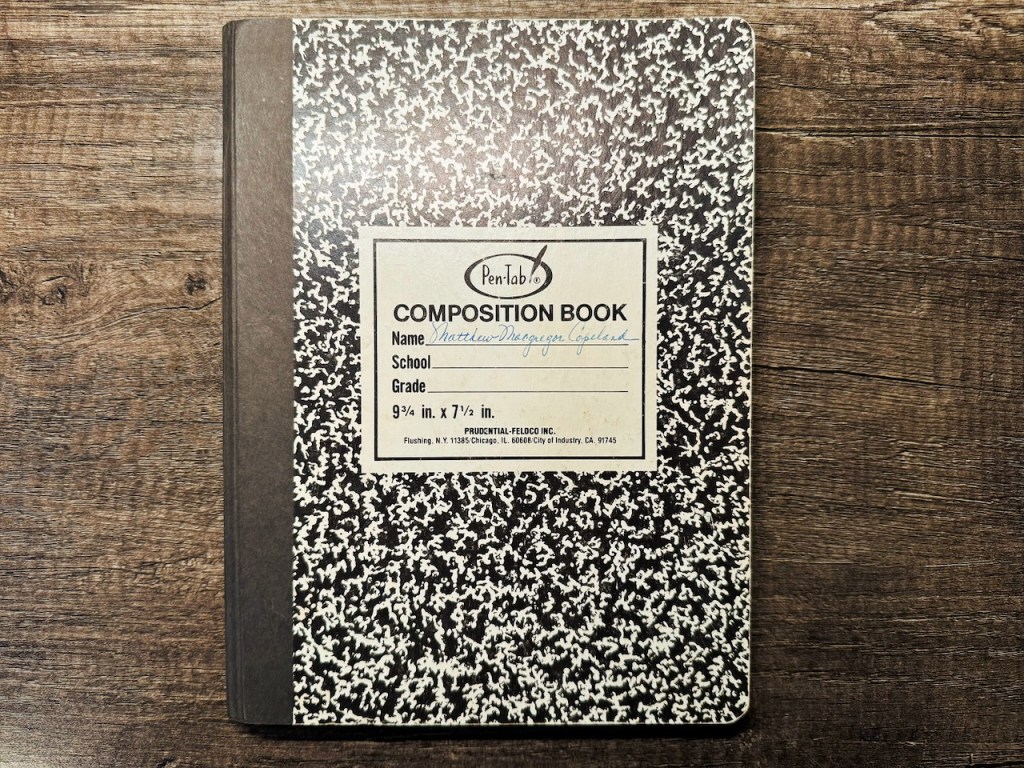
But I haven’t used one in ages.
My last journal was a softcover Midori MD A5, a luxurious Japanese piece of art with elegant design and high-end function. The exquisite paper has an inviting warm hue, and gladly accepts all kinds of ink without ghosting or bleed-through.
The Midori is wonderful, and there are plenty of others that I have similar affection for. I find new favorite notebooks much faster than I can fill them.
The best journals encourage me to write. They call to me to sit down and have a discussion with the page, working through challenges I didn’t even know I was facing.
Even “expensive” journals offer great return on investment. I know that for about $15 I can spend a month or two with a Porsche of stationary; it’s an affordable luxury and a lot cheaper than therapy. At first I wasn’t sure about replacing my beloved Midori with a utilitarian $3 commodity, like trading in that Porsche for a base model Corolla.
But I am also attracted to minimalism and value. I aim to fit things to their purpose, to get the most out of them.
I generally do not keep my journals; they’re ephemeral (I have plenty of other notebooks piling up for posterity). My journals are not for record-keeping or future reference. They’re to work through ideas and thoughts in the moment. Most of what I write in them is nonsense and my actual “final answer” is often far from the words on the page; sometimes it’s the exact opposite.
So I have mixed feelings about sending that artfully crafted Midori through the shredder when its pages are exhausted. Is this its highest and best use?
Perhaps the humble composition book is more suited to to be the scratch paper for my fleeting thoughts.
Of course I also love pens, including fountain pens. But for this kind of journaling I am a big fan of a basic ballpoint; the Bic Cristal is a favorite. The smoothness and simplicity complement the goal of eliminating friction between the mind and the page.
So I had this idea that an ideal ephemeral journaling package might be a $3 composition book paired with a $0.25 Cristal.
I’ve now been using the composition book in this way for about a month. I writing in it daily, often twice a day. I’ve used up most of the 100 sheets.
The paper is thin and, especially after I’ve written on it with a ballpoint pen, develops a crinkly sound and feel that is kind of like parchment. Sometimes I find the added texture and sensory experience endearing; sometimes I find it chintzy.
Fountain pen ink bleeds through, as expected.
The book lays flat, but the bump of folded pages at the binding gets in the way when writing near the center; this is annoying.
Are any of these things deal breakers in a $3 notebook? Of course not.
From a minimalist perspective there’s a lot to like.
It’s lightweight and easily slides into the tablet slot in my backpack (FWIW I highly recommend replacing your tablet with a notebook).
It efficiently does what it’s supposed to. While “luxury” notebooks won’t break the bank, this one is still an order of magnitude less expensive and provides most of the benefit. It’s the Pareto Principle in action.
As with most notebooks, I’ve become more attached to the composition book as it breaks in and develops character. That black and white marble cover now sparks feelings of comfort, peace, and harmony more than memories of school assignments. It’s more my mom’s journal and less fourth grade English class.
The experience of watching my perception of the notebook change over time has been a worthwhile exercise. Committing to filling it before moving on has given me a chance to see this play out. My opinion today has evolved from expectations and initial impressions.
Even if you’re a diehard fan of Midori, Leuchtturm, Muji, or Moleskine—I suggest you spend a month with the humble composition book and an old school Bic. You may be surprised by what you learn.
Want more posts about notebooks, journals, productivity, personal knowledge management, and self-development?
 Matt's Blog
Leave a comment